How to decide
A practical guide to assessing the surgeon, the procedure and the facility — whether you choose this practice or another. The aim is a decision based on information rather than on advertising.
First: verify the licence and the specialty
In the Kingdom, medical practice is tied to classification and licensing by the Saudi Commission for Health Specialties, and the facility itself must be licensed by the Ministry of Health. Both are verifiable, and you are entitled to ask about them directly.
- Is the classification specifically "Consultant, Plastic and Reconstructive Surgery"? The phrase "cosmetic doctor" alone does not mean plastic surgeon. Quite different specialties are sometimes presented under the same heading.
- Where was the specialty training completed, and how long did it take? Accredited plastic surgery programmes run for years and carry a recognised board certificate.
- Is the facility licensed for this type of surgery specifically? Not every clinic is equipped for procedures requiring general anaesthesia.
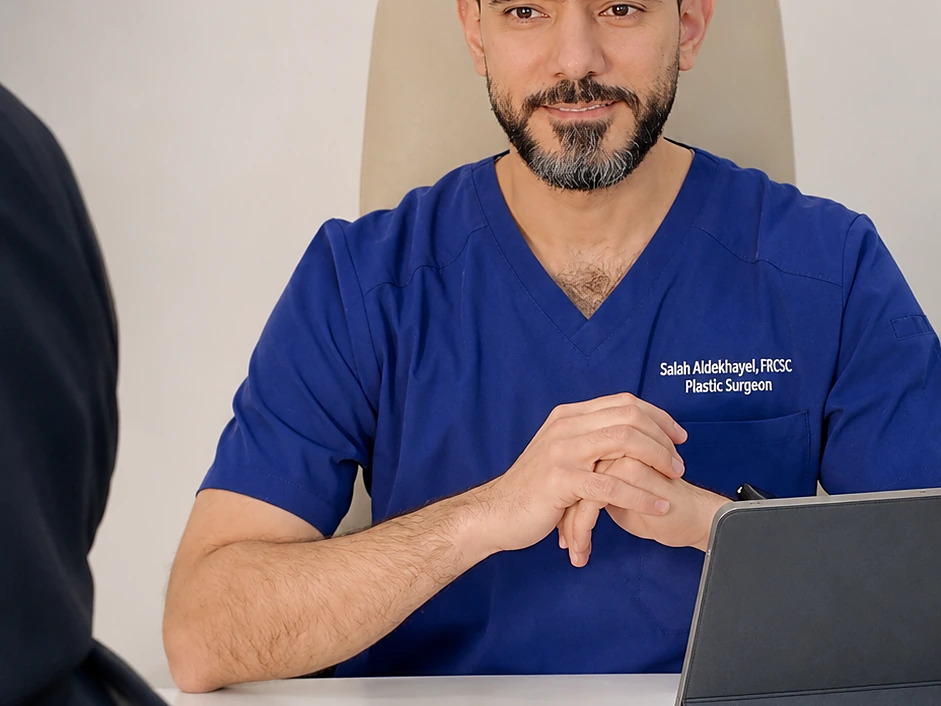
The seven questions worth asking
Take these into any consultation. How they are answered matters as much as the answer itself; a surgeon who avoids discussing complications has told you something about himself.
- Am I a suitable candidate for this procedure, and why? Look for reasoning based on your examination, not on the procedure in general.
- What are the alternatives, including not operating? There should always be an alternative on the table.
- What are the three most common complications of this specific operation? A general answer such as "there are no risks" is reason enough to leave.
- What type of anaesthesia, and who will administer it? It should be a specialist anaesthetist, in an equipped facility.
- What is the real recovery period? When do I return to work, when to exercise, and when does the final result settle — three different numbers.
- If a complication occurs, who manages it and how do I make contact? The most important question, and the least often asked.
- What is the all-inclusive cost? Anaesthesia, facility, follow-up, garments, and the possibility of a later revision.
Signs to stop
- A guaranteed result. No one can guarantee a surgical outcome. Human tissue responds differently from person to person.
- Offers, discounts and countdown timers. A surgical decision is not made under time or price pressure.
- A decision at first contact without examination. If the procedure and the date are set before anyone has examined you, you are in a sales process, not a medical consultation.
- Price discussed before suitability. The order matters.
- Ambiguity about who will actually operate. Ask plainly: who is holding the scalpel?
- Before-and-after images offered as the only evidence. Images can be selected and edited, and someone else's anatomy is not yours.
On cheap surgery abroad
Large price differences in medical tourism rarely come from greater competence. They come from somewhere: the number of operations per day, the standard of the facility, the experience of the team, or the follow-up — and follow-up is the first thing cut.
The core problem is not the operation itself but what comes after it. Surgical complications do not all appear in the first few days; some emerge weeks later, by which time you may be home with no one responsible for your care. Correcting an unsatisfactory result is harder — and more expensive — than doing it properly the first time.
If you are considering travelling, add one question: who will treat me if a complication develops after I return? If there is no clear answer, reconsider.
Realistic expectations
Cosmetic surgery improves appearance; it does not change a life. The most satisfied people are those who arrive with a specific, realistic goal ("I want to address this particular area") rather than a vague one ("I want to feel differently about myself").
The final result also takes time. Swelling after contouring procedures can persist for weeks to months, and scars need twelve to eighteen months to mature and fade. Judging a result in the second week is always judging it too early.
A consultation starts with a question, not a booking.
Send your enquiry on WhatsApp and a member of the team will reply during working hours to arrange a suitable appointment.